Search the Record 


View past issues
Record


e-Record
Subscribe to
receive Record
headlines
via e-mail

Washington University in St. Louis

April 21, 2006
Vol. 30, No. 30

Front Page
Medical News
Calendar
Notables
Campus Watch
Sports
Record Staff
Employment

Daniel Brennan
is a department of one


To Current Issue
Aug. 13, 2008


Comments,
story ideas

E-mail the Record


April 21, 2006 > One gene provides fruit fly both antenna & color vision

One gene provides fruit fly both antenna & color vision

By Tony Fitzpatrick

A team of researchers that includes WUSTL biologists has discovered that a gene involved in the development and function of the fruit fly antenna also gives the organism its color vision.
FruitFly
Photo by David Kilper
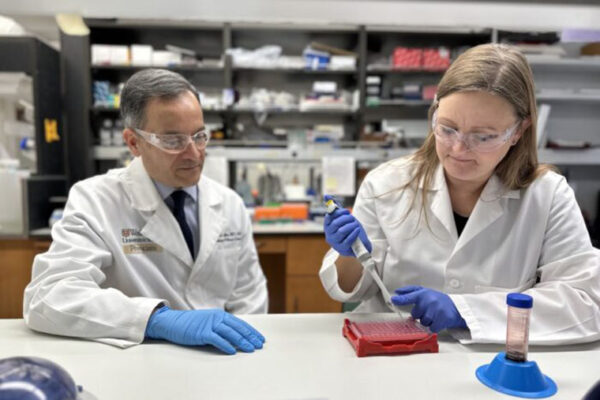
Dianne and Ian Duncan examine fruit fly (Drosophila) specimens in their lab. The husband-and-wife duo in the Department of Biology in Arts & Sciences provided fruit fly clones and mutants and technical assistance that helped locate where a gene called "spineless" is expressed in the retina.

Claude Desplan, Ph.D., professor of biology at New York University, and his students made the discovery and provided the data. Ian Duncan, WUSTL professor of biology in Arts & Sciences, and his wife, research assistant Dianne Duncan, provided the Desplan laboratory fruit fly (Drosophila) clones and mutants and technical assistance that helped locate where the gene, called "spineless," is expressed in the retina.

The Duncans have a long history with the spineless gene. Their interest has been in the role spineless plays in directing development of the antenna, Drosophila's primary olfactory organ. Years ago, they deleted the spineless gene and found that the mutants then produced a leg instead of an antenna.

"Spineless plays a key role in the antenna and maxillary palp, the two major olfactory organs of the fly," Ian Duncan said. "It's also important in mechanosensory bristles and in the taste receptors of the legs, wings and mouth parts. There has been a sensory theme to the gene, and now we learn from Claude's work that it plays a key role in color vision."

In humans, the closest known homolog (counterpart) is the arylhydrocarbon ("dioxin") receptor, a key protein in human health that senses a wide variety of synthetic compounds and then activates expression of detoxification genes.

The dioxin receptor is studied closely in cancer biology and toxicology.

Recently, the Duncans had found a relationship between spineless and a gene called "homothorax."

Desplan's group had shown that homothorax plays an important role in the Drosophila eye, and after hearing Ian Duncan make a presentation on the homothorax-spineless relationship in the antenna, the Desplan laboratory decided to study spineless in the eye.

The collaborators published their results in a recent issue of Nature.

Random pattern

The Drosophila retina comprises clusters of photosensitive cells called ommatidia. Two types of ommatidia are present; one is sensitive to long-wave light and the other to short-wave light.

This difference is due to the expression of different light-sensitive pigments (rhodopsins) in the two central photoreceptor cells (R7 and R8) of each ommatidial cluster. Spineless determines the long-wave type by activating expression of rhodopsin-4 in R7 cells. In ommatidia where spineless is not expressed, R7 expresses the short-wave sensitive rhodopsin-3.

"The fascinating thing in this work is that the longer wavelength-sensitive ommatidia are randomly positioned," Ian Duncan said.

"About 70 percent of the ommatidia sense longer wavelength and 30 percent sense short wavelength. It's been a mystery how you generate a random pattern like that and still have that ratio."

Using the tools that the Duncan laboratory provided, Desplan's group mapped the regulatory region in the spineless gene that drives the random pattern mechanism.

"Nobody knew what controlled this random pattern," Dianne Duncan said. "Now we know it's spineless.

"We've known for a while that spineless has several sensory functions, and we thought it might be a bit underrated in developmental biology.

"Now we add color vision to its duties."

Spineless also appears to control communication between the R7 and R8 photoreceptors.

"It has been known for some time that the expression of rhodopsin genes in R7 and R8 is coupled with the particular genes expressed in R8 being determined by the adjacent R7 cells," Ian Duncan said.

"An additional important finding in the paper is that spineless controls this signaling between R7 and R8."

Link to human odor

The Duncans will continue to look for other genes that spineless controls in making an antenna.

They have shown that spineless acts together with two other factors, Homothorax and Distalless, and identified downstream target genes by virtue of their having clustered binding sites for these factors.

And they are looking into similarities between spineless and the mammalian dioxin receptor.

In a collaboration with a University of Wisconsin researcher, they have put the mammalian dioxin receptor gene into Drosophila, where, surprisingly, it specifies the making of an antenna.

"When you think about it, the antenna is quite special," Dianne Duncan said.

"It contains many proteins not expressed anywhere else in the fly. These include many odor receptor proteins that are expressed in subsets of cells within the antenna.

"Our hope is that by unraveling how development of the Drosophila antenna is controlled, we will gain important insights into how human odor perception works."


News & Information  |   WUSTL Home  |   To Current Record Issue

Front Page | Medical News | Calendar | Notables | Campus Watch | Sports
Washington People | Record Staff | Employment | WUSTL Magazine | Outlook Magazine

The Record is the University's weekly newspaper for faculty, staff and students.

Questions or comments? E-mail the editor or call (314) 935-6603.
Problems with this site? E-mail our Web team.
Copyright ©2003-06 Washington University in St. Louis.  All Rights Reserved.