|  | 
Jonathan Chase named director of Tyson Research Center
 Jonathan M. Chase, Ph.D., associate professor of biology in Arts & Sciences, has been named director of the Tyson Research Center. Above, he and Ruth Poland, a senior in the Environmental Studies Program in Arts & Sciences, examine a spotted salamander larvae in one of the Tyson Research Center ponds. Chase is only the third permanent director to oversee research and activities at the 2,000-acre field site since 1970.
Genetic finding sheds light on blood vessel breakdown
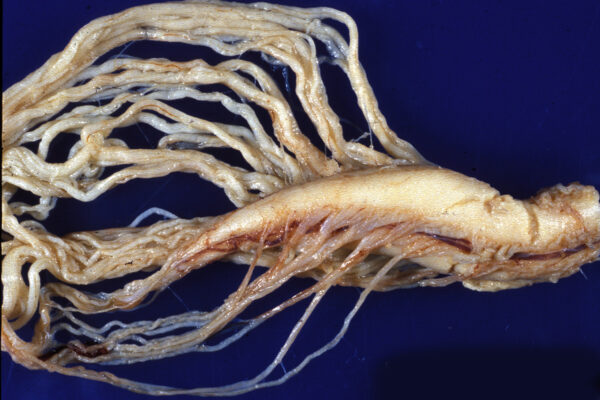
 Twenty-one years after they first described a fatal genetic disorder in Missouri and Arkansas families, School of Medicine scientists found mutations in a gene that will help to understand and treat retinal vasculopathy with cerebral leukodystrophy.
WUSTL engineers find common ground in brain folding, heart development
 Engineers at Washington University in St. Louis are finding common ground between the shaping of the brain and the heart during embryonic development. Larry A.Taber, Ph.D., the Dennis and Barbara Kessler Professor of Biomedical Engineering, and Philip Bayly, Ph.D., the Hughes Professor of Mechanical Engineering, are examining mechanical and developmental processes that occur in the folding of the brain's surface, or cortex, which gives the higher mammalian brain more surface area (and hence more intellectual capacity) than a brain of comparable volume with a smooth surface.
Retirees honored by University at luncheon
 Chancellor Mark S. Wrighton hosted a luncheon Sept. 25 to celebrate the contribution of 72 recent retirees to the University. "Today, people at Washington University are benefiting from your hard work," Wrighton told the retirees. "On behalf of everyone at Washington University, you have my thanks and appreciation for all that you've done to make this the great place that it is; a great place for a wonderful education, a great place to work and, in many respects, a place that brings benefits well beyond St. Louis."
Children respond to 'active' programs for getting fit, eating balanced diet
 A little health information is not enough to help obese children get into better shape, according to a recent analysis. Moreover, children who do not receive an offer for intervention or who receive information only tend to experience weight gains. Children given guidance that is more direct get into better shape, according to the review. "Providing information is a necessary component, but it's not sufficient," said Denise Wilfley, Ph.D., lead author of the study and professor of psychiatry at the School of Medicine.
 |  | |