Breathing new life into Bohemian Hill

By Ann Nicholson

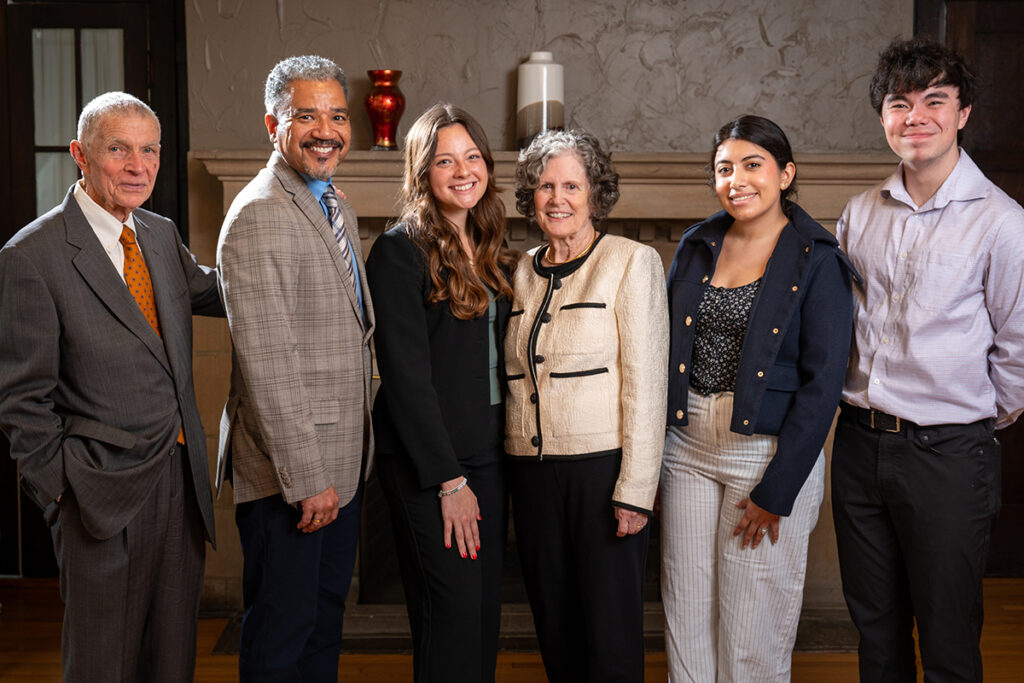
Jo Noero, the Ruth and Norman Moore Professor of Architecture, right, and Donald Royse, professor emeritus of architecture, left, explain new housing proposed for St. Louis' Bohemian Hill at a recent project groundbreaking. From left are Royse; Bob Brandhorst, executive director of Youth Education and Health in Soulard (YEHS); Isa Aziz, YEHS board member and a Bohemian Hill resident; Christine Gardner of the Missouri Department of Economic Development; and Noero.

Inspired by the results of a design exercise for a couple of graduate students, three architecture faculty members are pooling their talents to transform Bohemian Hill, a blighted area on St. Louis' near South Side, into vibrant new housing.

The metamorphosis of the five-block "no man's land" is a fitting challenge for Jo Noero, the Ruth and Norman Moore Professor of Architecture and director of the graduate program; Donald Royse, professor emeritus of architecture; and Carolyn Toft, lecturer.

Noero, who is currently designing the Apartheid Museum in Port Elizabeth, South Africa, launched his architectural career building desperately needed housing and education centers for black South African communities. Royse, St. Louis' first director of urban design from 1990 to 1993, has played an integral role in urban revitalization projects. Toft, executive director of Landmarks Association of St. Louis, spearheads the nonprofit organization's diverse efforts to preserve St. Louis' architectural heritage.

Partnering with YouthBuild St. Louis AmeriCorps, an educational and construction training program for at-risk youths, and the Bohemian Hill Redevelopment Steering Committee, the three faculty members recently broke ground on two prototype houses. Designed by Noero and Royse, the homes will be at the intersection of Soulard and 13th streets and are the first in an overall proposal for 67 new houses and 45 rehabilitated homes and apartments.

"The Bohemian Hill project shows how high-quality, contemporary design can complement existing historic design without mimicking historic design," Noero said. "We are not only offering new, single-family housing in the city of St. Louis at an affordable price, but also demonstrating how quality design can reinvigorate declining urban areas."

Bounded by Tucker Boulevard, Lafayette Avenue and Interstates 44 and 55, Bohemian Hill lies east of Lafayette Square and west of the Soulard and LaSalle Park neighborhoods. The site is across from the abandoned City Hospital and the former Darst-Webbe public housing complex, which is being replaced by a federally funded, mixed-income housing development.

Originally home to immigrants from Eastern Europe, Bohemian Hill experienced an ongoing period of decline after a number of the homes were demolished to make way for the Darst-Webbe project and interchanges for Interstates 44 and 55. The area has 30 remaining historic buildings, most unoccupied, and vacant tracts of land.

"There was generally a feeling that there was not enough left here, that there was not enough density or context for a historic district," Toft said. "That is correct, but when you come out to the site, you realize that it is a prime location with phenomenal vistas taking in the wonderful silhouettes of nearby church steeples. It has tremendous potential. Jo and Don were willing to take the leap, and it has led to a wonderful partnership and a real commitment to reinvent the city."

During the 1998 spring semester, two of Royse and Toft's graduate architecture students, Jill Nishimoto and Rohn MacNulty, designed contemporary housing units for the site as part of a theoretical design project. After receiving favorable feedback from the community, Royse and Toft decided to expand upon these initial themes and pursue an actual housing development.

The Youth Education and Health in Soulard (YEHS) organization, which runs the local YouthBuild program and has worked closely with Landmarks, joined the effort and secured a $100,000 grant from the Missouri Department of Economic Development. Toft also helped form the Bohemian Hill Steering Committee, made up of homebuilders, residents and business and civic leaders.

Royse and Noero were hired last fall to design prototype homes and create an overall site plan and model for the project, which includes public green space. Their proposal is the result of months of fine tuning based on community input. The YEHS grant, which will cover part of the construction cost of the first two homes, funded the overall preliminary design work, including the site model built by Amit Patel, a 1997 graduate of the School of Architecture. Additional funding is being sought for the remaining homes, which would vary in size and design, and for restoration and conversion of the historic buildings.

Construction on the first two homes is expected to begin this summer with the houses ready for occupancy next spring. YouthBuild will provide much of the labor for the new residences, which have an estimated market value of $125,000 each.

The two-story, 1,300-square-foot homes will have private outside decks, skylights, living rooms with bay windows, three bedrooms, kitchen and dining areas, and a side entrance to reduce the need for hallway space inside. Brick will wrap around the exterior façade to the side entryway and complement the character of the neighborhood's historic buildings.

"We wanted to design a unit that is as compact as possible, but still gives all the amenities and offers a quality and grace to the neighborhood," Royse said. "The houses are designed to create a real sense of community identity."

Bob Brandhorst, YEHS executive director, said the project is ideal because it will train YouthBuild participants for jobs in new construction. "Our work in the past has focused on renovation of older buildings," he said. "This is the first time the young people will be able to help build new housing and use new, sustainable building materials and techniques. The contemporary quality of the design also will really drive the evolution of the neighborhood."

----------------------------------------------------------------------