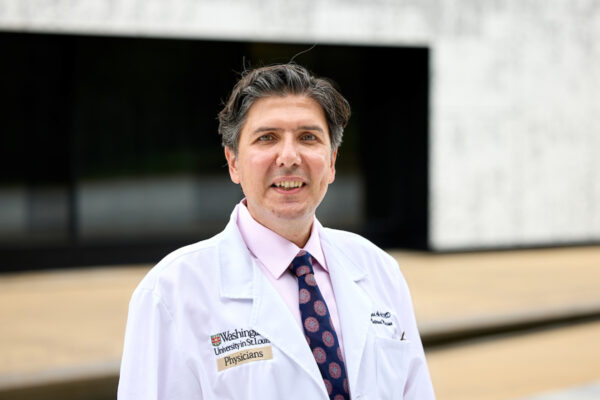
Douglas C. Schmidt, Ph.D., associate professor of computer science and at the School of Medicine's Mallinckrodt Institute of Radiology, has authored more than 100 scholarly publications and traveled the world giving computing tutorials and lectures. Affable, animated and power-packed from 20 years of weight-training and ballroom dancing, he is recognized as one of the most dynamic young teachers in the School of Engineering and Applied Science.
Schmidt said at least part of his international success in computing is owed to his impatient nature. "I'm fundamentally impatient and find doing the same things over and over again frustrating and a waste of time," Schmidt said in his fifth-floor Bryan Hall office, in which a prominent feature is a poster of Arnold Schwarzenneger in his pre-"Terminator" days.
"As a graduate student, I began to see that there was a lot of commonality in the software arena," he continued. "Diverse companies, laboratories and institutions were having to spend countless hours and lots of money to write software from scratch for their applications, despite the fact that most of the software functions shared a lot of common features that were not being exploited. What was needed was a core middleware infrastructure that could be used over and over again with diverse operating systems, networks and hardware. The approach that I came up with is largely a way to avoid busywork and redundancy."
The concept Schmidt pondered in his graduate school days has led to the development of packages he's named ACE and TAO (pronounced "dow") now being used in organizations ranging from the U.S. Navy to the CERN Physics Laboratory in Switzerland to Boeing Advanced Avionics Systems and Siemens Medical Instruments Corp., among many others.
ACE and TAO inhabit the domain of what is called middleware, a layer of computer software that has grown increasingly important for a host of applications. ACE provides software components that shield applications developers from operating system differences, so that applications can be written on any kind of operating system. It is a kind of flak jacket that keeps proprietary commands or functions from interfering with application portability.
![]() |
Consider Boeing, makers of the F-15, F/A-18 and the famous AV8/B, or Harrier Jet. They are using ACE and TAO to design and build the next generation models of all three products. While the three models are quite different physically, the various functions -- or logic routines -- that the computing systems perform to navigate the crafts and control the weapons are nearly identical in all instances.
"Boeing was building all the software for those planes from scratch, over and over again," Schmidt explained. "What ACE and TAO provide is a way to have a common software architecture for them all. This middleware infrastructure allows Boeing to make planes basically all work the same from a software point of view, rather than having to redevelop the functions independently multiple times."
The giant medical imaging company Siemens was in a similar dilemma. Siemens manufactures computed-tomography, ultrasound and magnetic resonance imaging instruments throughout the world. In the 1990s, Siemens conceived an ambitious project to come up with a common software architecture that would be the foundation for the instrument control processes of their different machines. Siemens representatives contacted Schmidt, after learning of work he and his group were doing with Barnes-Jewish Hospital and the medical school's Electronics Radiology Laboratory. Schmidt began working with Siemens in 1994, his first year at the University, and they have sponsored his work ever since.
To understand ACE and TAO, it's helpful to think of computer systems as comprised of layers like a cake or a stack of pancakes. The stacking is aligned like this: the network and hardware are on the bottom, followed by the operating system -- Unix, Windows NT, Windows 95, for example -- then, in Schmidt's scheme, ACE and TAO middleware, and finally the application. Each layer is "conversant" with the other through interfaces and protocols to achieve the end result of the application, say navigating a fighter airplane or transmitting a medical image.
While ACE effectively hides operating systems differences, TAO is used to shield yet more details from a system's lower-level software and hardware. TAO has made its biggest impact by enhancing time-critical applications such as fighter aircraft, air traffic control, medical image acquisition and multimedia, such as teleconferencing.
"Everything we've done with ACE and TAO and some other projects as well is available on the Internet," he said. "People can download the software we've built and make their own adjustments. We then integrate their suggestions, resulting in better R & D products. We can literally work with people around the world in every time zone every hour of the day."
Schmidt's Web site averages 600 hits a day from around the world. The visibility in part has led to the development of spin-off companies in St. Louis and elsewhere specializing in ACE and TAO and to landing top-notch graduate and undergraduate students.
![]() |
Schmidt is highly valued by his department and the engineering school, according to Catalin Roman, Ph.D., professor and chair of the Department of Computer Science.
"Doug is pure energy," Roman said. "Everything he does is an Olympic event, be it teaching a new and innovating class, getting his work in print or raising money for his ambitious research agenda. It is indeed rare for a young faculty member to bring so much visibility to the department and the University in such a short time span."
Schmidt teaches two undergraduate courses, one in operating systems and the other in design patterns and frameworks. He also teaches graduate courses in operating systems and distributed system software development.
Schmidt's accomplishments are all the more impressive considering his background. He holds bachelor's and master's degrees in sociology, attained in 1984 and 1986, respectively, from the College of William and Mary. While pursuing the master's degree, he found himself drawn into the lure of computing just when the personal computer revolution was taking off.
He was accepted into the computer science program at the University of California-Irvine on the strength of his potential and strong recommendations, one of which came from a weightlifting buddy at William and Mary who just happened to be a professor of computer science.
Schmidt said studying sociology provided him insight into group dynamics and group psychology, and the writing and speaking abilities he has honed have been helpful as a computer scientist.
"I was drawn to sociology because of my fascination with how groups work," he said. "The background has helped me speak to groups, get grants, motivate students and understand social dynamic interactions. It's a misconception about computer science that it's entirely mathematical. Computing is about being able to reason abstractly. Math is certainly one way to do that but not the only way. Creative, expressive people can find a good niche in computer science."
| Front Page |
Medical News |
Calendar | Campus Watch |
More Campus News |
Notables | Email Us! |
| News Briefs |
Sports | Obituaries | Record Staff |
Hilltop Jobs Medical Jobs |
WU Home Page |