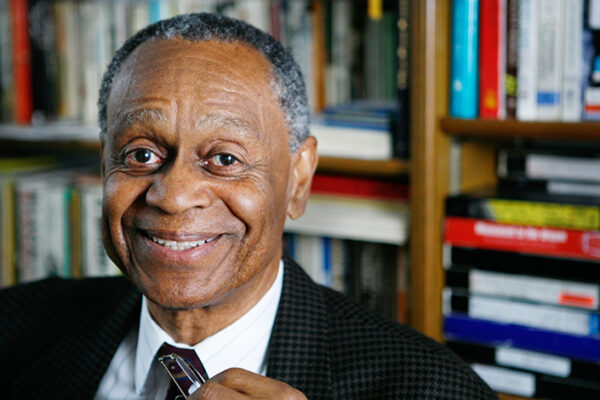
The lifework of South African architect Jo Noero is firmly grounded in a social conscience -- using fine form not as a monument to itself, but as the foundation for making lives better.
"Architecture is first and foremost a social art that is shaped by people and society," said Noero, the Ruth E. and Norman G. Moore Professor of Architecture. "In the last 10 to 15 years, there has been a movement for the autonomy of form in architecture that is independent of use, climate, materials and site. A lot of ground has to be recaptured. Architecture is very important to society and architects have an important role to play in serving society."
Having been deeply involved in the anti-apartheid movement in South Africa, Noero understands the power of grassroots building projects to reverse the plight of the downtrodden. Working alongside Anglican leader Desmond Tutu and black community activists, Noero discovered how architecture -- initially used by the South African government as a tool of oppression and racial segregation -- could be transformed under the resistance movement to create a sense of hope and belonging.
In the early 1980s, Tutu appointed Noero as the architect for the Anglican Church in Transvaal, South Africa. Through Tutu, Noero became involved in the effort to train local black people in construction skills for building desperately needed housing units using readily available materials.
"Tutu believes in a non-racially divided democratic society, and his commitment is unwavering," Noero recalled. "He is an extraordinary and deeply religious man. When many people were going into exile, he was one of the few people who still had a public voice. The way he dealt with the apartheid government was truly inspirational."
Throughout the next decade of tremendous political upheaval and change, Noero continued designing community-based projects in South Africa. In recognition of his work with the disadvantaged, Noero received in 1993 the prestigious Ruth and Ralph Erskine Fellowship from the Swedish Academy of the Arts and Architecture. Noero was awarded the fellowship, which is presented every two years to an international architect, for his educational centers in Soweto and Duduza.
The creation of the Duduza Resource Center, for which Noero also won a 1993 Institute of South African Architects (ISAA) National Award of Merit, was initiated by community members. The initial goal was to build a center to house informal educational projects to address a severe lack of basic skills among black residents. Open 24 hours a day, the multifunctional center is an integral part of the community.
In Soweto, Noero's addition to that township's career center won a 1994 ISAA Award for Excellence. The result of extensive consultation with area leaders, the facility is designed to exude a feeling of empowerment.
Noero's recent work under South African President Nelson Mandela's government has involved designs for a new court facility, housing projects, office buildings and community centers. His major projects include the construction of a youth sports center in Cape Town, which was commissioned by the South African National Sports Congress, and plans for 30 arts centers in rural South Africa, commissioned by the country's Ministry of Arts and Culture.
When he embarked on his professional career, Noero planned to become a doctor but had to drop out of medical school because, he said, he was unable to face a cadaver -- let alone cut into one. He then developed an interest in architecture while traveling in Brazil.
He received a bachelor of architecture degree at the University of Natal, South Africa, in 1977, and earned a master of philosophy in architecture in 1980 from the University of Newcastle-Upon-Tyne in England. In the mid 1980s, he became an architecture professor at the University of Witwatersrand in Johannesburg and established what has become an award-winning international architectural practice.
Noero joined the Washington University architecture faculty last fall and became head of the school's graduate program. He was installed as the Ruth E. and Norman G. Moore Professor of Architecture on Aug. 29. While he and his wife, Gillian, and their three children now reside in Webster Groves, Noero plans to continue his architectural practice in South Africa as well as establish one in St. Louis.
Architecture Dean Cynthia Weese, FAIA, said Noero's joining the architecture faculty has deepened the school's commitment to understanding other architectural cultures and the importance of culture in architecture. She added that Noero's exemplary design skills and his experiences as a community-based practitioner are invaluable assets to his teaching.
"We in the school strongly believe that architecture can powerfully enrich people's lives. We also believe this should be available to all people, advantaged and less advantaged," Weese said. "Jo's strong advocacy for the importance of fine buildings that reflect and respond to an entire culture is important to everyone at the school."
Tim Franke, assistant professor of architecture, who has worked closely with Noero on a housing project in South Africa, added: "One of the important attributes that Jo brings to the school is his intense desire to deliver architecture that is derived from one's understanding of the human condition.
"Form and artistry are driven by his focus on context and are built upon a belief that architecture is as much about social support and reconstruction as perhaps any other endeavor," Franke said.
Above all, Noero's work demonstrates that architecture designed to meet a social need also can exhibit fine form and provide for its occupants a direct means of identifying with it. Noero stresses to his students that the way to resist the homogenization of architecture in an increasingly global society is to focus on the context and culture in which one is building.
"I introduce in the studio the idea that really fine, authentic architecture springs from a sense of place and understanding of critical regionalism," he said.
Noero believes that many of the architectural lessons learned in South Africa are applicable to the United States. Having dealt firsthand with the destitute conditions of black South Africans, Noero said he is puzzled by the problem of homelessness here.
"Americans say they have a housing problem, but there are wonderful buildings here that are vacant and could be used for housing," he observed. "I come from a society where people built shacks for lack of somewhere to live. Here, people seem paralyzed to do anything."
"Architecture students are exposed to different fields of study, from engineering to cultural history to architectural theory to economics. The design studio is the arena in which these different fields are synthesized," Noero said.
As head of the graduate program, Noero also plans to reintroduce the idea of a design thesis for students to complete before they obtain a master's degree. "It will be a self-initiated project that will be reviewed by a board of eminent practitioners and academics as the culminating point of a student's course of study," he said.
The idea of architecture being central to community solutions is a common theme in Noero's studios, said graduate student Mike Hauser, who last spring participated in a studio that focused on how design techniques and urban planning could be used to reverse urban decay along Manchester Road in St. Louis.
"Professor Noero stresses that people should be included in the dialogue on any community project," Hauser said. "There are so many social issues involved that tend to get put aside when a developer makes all the decisions. He also really gets your mind churning and forces you to focus on how a building is going to be used and who is going to use it."
In a project slated for next spring, students will work with community leaders to create a sustainable neighborhood in north St. Louis. The project calls for establishing a series of building centers for skills training and small businesses to foster a self-sufficient community. The students also will help rehabilitate some of the housing in the area and teach residents rehab skills.
Noero's belief in community empowerment and the restorative powers of a self-sustaining environment is demonstrated in a mixed-use housing project that Franke and he currently are designing in Johannesburg. The project links the disparate South African communities of Wattville and Tamboville through a combination of low-cost housing, small business workshops, taxi stands, a marketplace, light industrial-use facilities (such as a fish hatchery, restaurant and greenhouse), and a productive landscape.
Noero and Franke's designs recently won second place in the international Housing Generator Competition held by the Urban Sector Network, a public interest group in South Africa, and the Rotterdam Academy of Architecture and Urban Planning, in the Netherlands. The project, which combines architectural and landscape architectural solutions, will be displayed in exhibitions in both South Africa and the Netherlands and will be published in a competition book. Drawings and a model of the project also are currently on display in the "Site As Context: Schools of Art and Architecture Faculty Projects" exhibit in University's Gallery of Art in Steinberg Hall.
The Johannesburg project is characterized by a sense of optimism. It fits in with Noero's belief in "working from first principle" -- focusing on the basic issues of climate, materials, landscape, space and use to shape architectural form.
"I strive to make buildings that are appropriate to the local context rather than a version of the ideal transplanted from somewhere else," Noero said. "The idea is to give unique expression to each place so that it becomes a specific place, and so that downtown here is not downtown everywhere."
--Ann Nicholson
Please send comments and suggestions to: