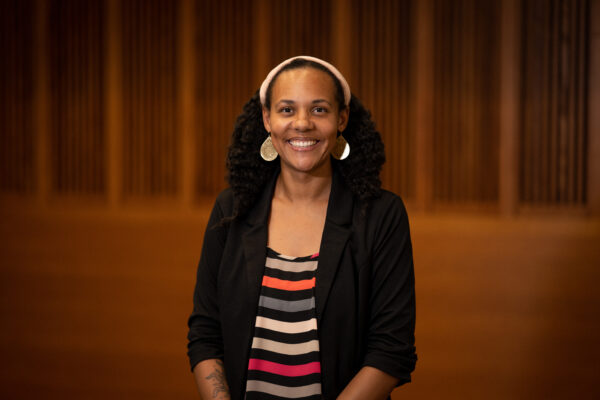
Suzanne Brown was just starting her second semester of law school when she was invited to be an international observer of the elections in El Salvador. She desperately wanted to go, but the trip would mean missing two weeks of school. She struggled with the decision. She agonized. Then she decided.
"In the end, it was clear to me that being a law student was what I was doing, but it wasn't who I was," she said. "The election was a significant, historical event. Participating in it and hopefully helping the voting process in Central America was who I was. I felt it was my world civic duty."
This event is reflective of much of Brown's life -- a life marked by idealistic thought and political action. It was activism that brought her to law school, sustained her during law school and will characterize her work after law school.
In 1993, Brown was directing the Immigration Project of a non-profit agency in downstate Illinois. Working as an accredited representative -- she has a master's degree in legal studies -- she helped clients from 78 countries with immigration-related legal matters, everything from getting their children into school to political asylum.
"I believed, and still do, that if we had an attorney on staff, we could provide more services," she said. To that end, she enrolled in the Washington University School of Law.
In November of her second year of law school, Brown received word that the Immigration Project would be shut down. "I couldn't tell 1,000 people that made up the project's caseload, 'Sorry, we can't help you anymore.' These people were desperate for assistance," she said.
The following January, she started the project as an independent agency. She assembled a board of directors. She wrote grant proposals. She managed the administrative work. She handled the caseload. In the first year, she raised $85,000.
"If we all had Suzanne's energy, there probably wouldn't be a deficit in this country," said Kathleen Clark, J.D., assistant professor of law.
Brown downplays what she's accomplished during law school.
"Being an older student has real advantages in terms of organizing time. I'm internally directed. I'm not in a competitive cycle in class. I'm never afraid to ask a question in class. Other students think, 'What does the professor want me to know?' I think, 'What do I want to know?' Also, I haven't had the anxiety of looking for a job, which is tremendously draining for students," she said.
What Brown has had to deal with is the anxiety of not being at the top of her class. Though she expects to graduate in the top quarter of her class, she's not used to being less than the best. "It was hard not to be able to give law school more time," she said. "But I had to remember why I was here, and it didn't have to do with class rank."
What it had to do with was furthering the goals of the Immigration Project.
"One of the amazing things about Suzanne," Clark said, "is the level of her commitment and idealism -- not pie-in-the-sky idealism but practical idealism. You couldn't ask for a better quality in a lawyer. If there were more publicity about lawyers like Suzanne, the legal profession would have a much better reputation."
The Immigration Project is the current focus of Brown's 25 years of political activism, which took root during the Vietnam War when she was an undergraduate at the University of Massachusetts in Amherst. Since then, she has lobbied for Common Cause, trained shelter workers for the National Coalition Against Domestic Violence and visited refugee camps in Honduras and Guatemala. Last year, the bilingual Brown was named to the Advisory Committee to the U.S. Senate's Democratic Task Force on Hispanic Concerns.
Since last year, Brown has been working at Danna Soraghan Stockenberg & McNary, the law firm of Gene McNary, former commissioner of immigration and naturalization. "It's a whole different practice," she said. "The immigration law is the same, but because people who come here can pay for services, the possible remedies are much broader."
For every year she works for the Clayton firm, the firm has agreed to donate $10,000 to the Immigration Project.
Brown's goal now is to raise enough money to make the Immigration Project self-sustaining and to do more organizing work in the community itself.
"I love what I do. It's my vocation. I put in long, hard hours. I've done it when there was no money. But I always feel that I'm the lucky one. It enriches me. And I think it's made me a better person.
"But I won't be with this project forever. To paraphrase the line from the Passover Seder -- 'Though we may not be able to finish the task, we must not be afraid to start.' Life is unending struggles," she said.
One of those struggles will come to a close this week as Brown receives a law degree on Friday, May 17. She will celebrate the occasion with her husband, Daniel Juarez, who also works for the Immigration Project; two children, Sarah, 22, and David, 20; nephew Matt Rosenberg, who's in her graduating law class; and her parents. Both her mother, Anna Lee Brown, and grandmother Rose Cohn Brown attended Washington University.
In addition to receiving a degree, Brown also has been awarded the Judge Myron D. Mills Administrative Law Award for a paper she wrote on immigration law and the Jack Garden Humanitarian Award for significant contributions to the law school or the community.
"When this is over, I'll be working 60 hours a week on my job," Brown said, "but I'll feel like I'll be on vacation."
-- Cheryl Jarvis
Please send comments and suggestions to: