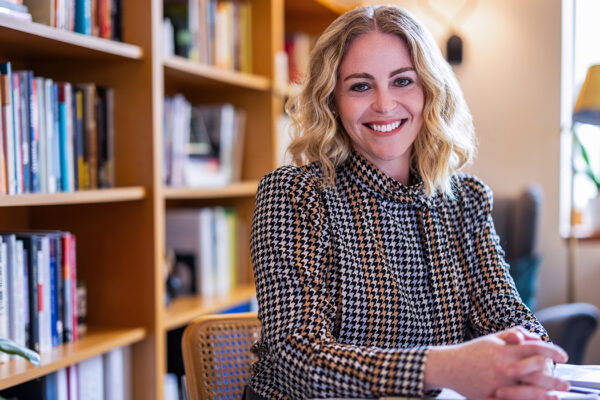
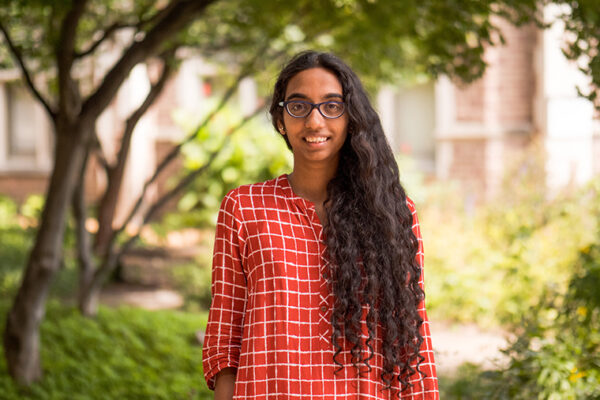
When Cynthia Weese, FAIA, came to Washington University in 1993 to serve as dean of the School of Architecture, her connection to the University and the school already had spanned more than 30 years.
Weese received bachelor's of science in architectural sciences and bachelor's of architecture degrees from the school in 1962 and 1965, respectively. She had served on the school's advisory board, the National Council, since 1988. She also made frequent campus visits -- to lecture and teach a studio class -- from her base in Chicago, where she was a principal in the Weese Langley Weese architectural firm.
As part of her involvement in the school, Weese helped in the search for Dean Constantine "Dinos" Michaelides' replacement. Michaelides, FAIA, announced in 1992 that he would retire the next year -- after 20 years as dean and 30 years at the University.
Weese, however, never thought the search would end up at her door.
"I knew that being a dean was a very difficult job and a very complicated one," Weese said. "I never once, in the process of helping the search committee look for Dinos' replacement, imagined that I'd ever do it."
So when Robert Virgil, D.B.A., chair of the search committee and then dean of the John M. Olin School of Business, asked her to consider becoming a candidate, she was "amazed and honored." After thinking it over and talking with her family, Weese was ready to be considered as a candidate.
"When Bob first asked me to become a candidate, I was very surprised. My response was that we needed to have a larger discussion that would include Ben (her husband). As partners (in both life and career), this was a life-changing decision for both of us. After talking with Ben and the rest of our family, I saw that it was possible, and I was ready to be a candidate."
Weese not only became a candidate but was selected as the new dean.
Because of her nearly 30 years as a practicing architect, Weese brings an important perspective to the school. She has seen where the profession is heading and what it demands of graduates.
"The architecture profession has changed greatly; we as educators have to deal with that," Weese said. "Architecture schools need to be ahead of change, to anticipate change rather than react to it. The design process trains architects to be good at creative problem-framing, information organization, analysis and synthesis. These are qualities needed in many endeavors besides architecture."
Weese has worked to identify and communicate the benefits of an architecture education.
Weese believes it's important for architects to assume leadership positions "not only on the complex teams that make buildings but in their communities as well. I tell students that architects also make very good mayors. If the Senate and House had as many architects as lawyers, our cities might look different," she said.
Architecture students, Weese said, also need to learn how to work with others in a collaborative effort. Once an architecture student learns how he or she works individually, the student needs to discover how to meld that work style into a team setting.
Weese's vision for the school also involves more outreach and partnerships with the city of St. Louis.
"I'd like to see us reach out to the rest of the University, to the city and to the world," Weese said. "There is a tremendous potential and lots of opportunities to revitalize the city, for example. Architects can help provide a vision and the expertise -- the impetus -- to help revitalize the city."
Some recent projects already have begun to involve working with the city. Associate Professor Jana Pereau runs a studio class in a Washington Avenue loft near downtown St. Louis. The students have built their own studio space and are helping redesign parts of the building with the owner. Pereau also has established a community design center in which she and architecture students will provide expertise to people in the city who can't afford professional architects.
David Block, a graduate student who is completing a combined degree in architecture and urban design, is working under the direction of John Hoal, director of urban design for the city of St. Louis and affiliate assistant professor of architecture, to help the city re-evaluate some of its neighborhoods to maximize usage in light of a declining city population size.
Weese also finds time to teach a year-long course for freshmen titled "Introduction to Architecture," in which students learn about the architecture school, the University and the history of design. Students take a tour of the city -- led by Hoal -- to understand its strengths and weaknesses.
Throughout the year, Weese invites people from throughout St. Louis and the University to talk about design. Past guests have included Jean Ensminger, Ph.D., associate professor of anthropology in Arts and Sciences, who talked about the design of structures of the people she studies in East Africa; Ursula Goodenough, Ph.D., professor of biology in Arts and Sciences, who talked about the design in cells; and Joseph Loewenstein, Ph.D., associate professor of English in Arts and Sciences, who talked about design in an Edmund Spenser poem.
"Cynthia is a woman of action," said Donald Royse, Ph.D., professor of architecture. "She's incredibly well-organized and gets a lot done. She also encourages everyone to raise their own activities to the same level. She's been very good for the school."
Warren Shapleigh, chair of the school's National Council and the recent recipient of the Dean's Medal for Service, commended Weese for her leadership.
"Since accepting the position of dean, Cynthia Weese has focused much of her time on developing our strategic-planning process. Right now, there's a lot of momentum for progress, and the school is fortunate to have Cynthia as its leader," said Shapleigh, who also is president of the Spencer T. and Ann W. Olin Foundation and an emeritus trustee.
Weese and Washington University almost passed each other like ships in the night.
"I had no idea Washington University existed until we came to St. Louis in August for a family vacation when I was 17," said Weese, who grew up in Iowa. "My parents had always wanted to take me and my sister to the St. Louis Zoo, but it was so hot we only lasted about 20 minutes. So we went to the art museum, where it was wonderfully cool. Later, as we left the museum and drove down the hill, we saw this amazing place (the University), so we drove up the oak drive and saw the building that said 'Architecture' on it."
Weese three years earlier had decided she wanted to be an architect, so she and her family went to Givens Hall. "We came into the building, my father and I," Weese recalled. "We came up the steps and into this very office (where she now sits). Joe Passonneau (then the dean) was there. He sat down right then and there to talk with us."
That visit marked the beginning of Weese's association with the architecture school and with Passonneau, FAIA, who continued to be her mentor for many years. "Joe was a counselor to everyone at the school. He always encouraged me, from the first time I met him," Weese said.
Weese met and married another mentor, Ben Weese, FAIA, while in architecture school. Ben Weese was a Chicago-based architect who taught for one semester in the urban research and design program.
"Ben has always supported me in my career," said Weese.
Their first date was April 4, 1963, and they were married three months later. But Weese was still in school, and her husband was back at his practice in Chicago, so they had a commuter marriage before commuter marriages existed.
On Friday afternoons, Weese would board a train in St. Louis and head to Chicago to spend weekends with her husband. Late on Sunday nights, she would board a Pullman sleeper in Chicago for the return trip to St. Louis. At about 6 on Monday mornings, the train would cross the Mississippi River via the lower level of the Eads Bridge. Weese was struck by the arches that helped support the upper portion of the bridge. Shortly thereafter, the train would roll into Union Station, under the great roof of the train shed.
"It was quite marvelous to come into the city that way," Weese recalled.
Now, 32 years and two children -- Dan, 30, and Catharine, 29 -- later, the couple have returned to another commuter relationship. This time, however, the airplane has replaced the train. Sometimes Ben comes to St. Louis, and sometimes Cynthia heads to Chicago. Weese quickly points out that it's much easier now after 30-plus years of marriage.
In 1970, Weese became a founding member of Chicago Women in Architecture, and in 1979, she became a founding member of the Chicago Architectural Club, whose members gather once a month to show each other their work and exchange ideas.
Weese has found inspiration and support from her fellow Chicago architects. "The whole architectural community has been an extremely important part of my life," she said.
She was a member of a "renegade" group of architects known as the "Chicago 7" (the "Chicago 11" when she joined). This group was "anti-Miesian." Ludwig Mies van der Rohe spawned a movement toward using lots of steel and glass in extremely large buildings, and he coined the term "less is more."
Weese also has been involved in the American Institute of Architects (AIA). She served as vice president and president of the Chicago chapter; as the Illinois regional director; and as vice president of the national organization. In fact, Weese had announced her candidacy for national president one week before being asked to be a candidate for dean of the architecture school. That plan, obviously, has been put on hold. In recognition of her contributions both to the profession and to the organization, she was named a fellow of the AIA in 1991.
Weese also has worked for several architectural firms, including one established by brother-in-law Harry Weese, FAIA. In 1977, Weese and her husband founded Weese Langley Weese, which still is in operation. Weese's son, Dan, also an architect, now works there.
Weese has designed a wide range of projects and has been recognized with numerous awards. Her projects have ranged from weekend and single-family homes to commercial projects, schools and high-rise apartments.
She is interested in the design concepts of light, scale (how the human body relates to the space) and the use of materials.
"Even though I had no idea of what it meant to be an architect back when I first decided to be one, I was clearly drawn to light, scale and space -- even as a child," she said. "Over the years, my reasons (for wanting to be an architect) changed, but it was always what I wanted to do. I never chose anything else."
-- Debby Aronson
Please send comments and suggestions to: