Archaeologist Fiona Marshall, Ph.D., has excavated many different materials -- bones, stone tools, fire pits, pottery, post holes, even ancient hut floors -- but last summer, she excavated tree roots that were threatening the oldest hominid footprints ever found, the Laetoli footprints in Tanzania, Africa.
Marshall, associate professor of anthropology in Arts and Sciences, was part of an international team commissioned to preserve the only known early hominid footprint trail dated at 3.5 million years old. The hominids (Australopithecus afarensis) who made these prints were ancestors of modern humans.
The footprints, which first were discovered in 1978 by famed paleontologist Mary Leakey, show three hominids walking north across an open plain and are among the most remarkable remains of early hominids -- easily the most dramatic evidence of early bi-pedalism.
The international team, a collaboration between the Getty Conservation Institute (GCI) in California and the Tanzanian government, is re-excavating, documenting and conserving the footprints and developing a plan for protecting them for posterity. The whole project is scheduled to take one or two more years.
In 1979, after Leakey and her team excavated and studied the footprints, they carefully reburied them under about two feet of soil -- a common way to preserve remains left in the ground. In recent years, scientists had become concerned as more and more trees and shrubs grew in the trackway.
"It was a bit like turning the soil in a garden," Marshall said. "The Leakey team created a microhabitat that was very good for acacia tree growth by putting 30 to 70 centimeters of sand on the footprints. Then they armored the top of the mound with big lava boulders to stop elephants from churning it up in the wet season. They hoped it would be less conducive to vegetation growth than it has been."
Marshall led the team that re-excavated the footprints. Other experts included conservators, geologists, botanists, photographers and scientists that study locomotion. One of the big unanswered questions is whether Australopithecus afarensis was better at swinging through trees or walking across the plains.
Last summer's excavation focused on about 10 meters of the southern portion of the hominid trackway, which is known as Laetoli Site G. Scientifically, the southern section of the trackway is by far the most important portion; it includes about 6.8 meters of the clearest and best preserved hominid prints.
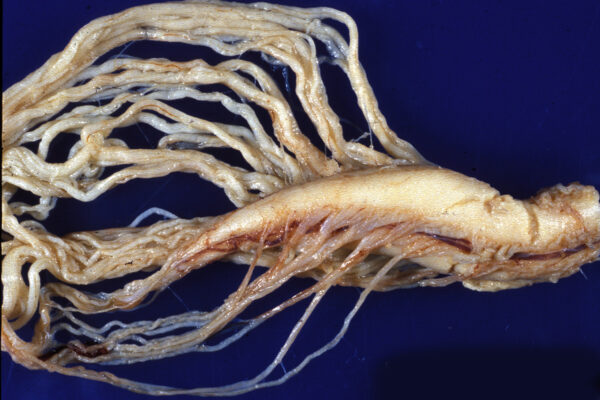
The trees were a major concern for Marshall's crew, which included two of her graduate students, Chester Cain and Francesca Alhaique. Thirty-five trees had grown in a 10-by-4.5-meter area, not including four trees that had been there since Leakey's excavation. Marshall, who will return to the site this summer, and her team excavated around the roots to determine where the trees had grown through the trackway and to re-expose the footprints so conservators could save what remained and scientists could study the footprints again.
"We had to excavate the roots as if they were archaeological features," said Marshall. "We did not know where they would end."
"It was truly amazing, a miracle and an enormous relief," said Marshall.
When Marshall's team discovered that the footprints were intact, they called Leakey, who still lives in Kenya in the house she and her late husband, Louis Leakey, built. (The team had a satellite phone for emergencies, and team members were allowed two-minute phone calls to their families every two weeks.) Leakey, who is in her 80s, sounded quite relieved, and arrangements were made immediately for her to visit the site.
Even more exciting than the hominid footprints alone was their relationship to the footprints of other animals, said Marshall. A three-toed horse and its foal appear to have galloped to the south. Other prints included those of hares and a small, jackal-sized carnivore. In addition, at a nearby site known as Site A, many other types of animal tracks were found by Leakey, including birds such as guinea fowl. Even raindrops were preserved in the volcanic ash.
"I knew the footprints would be exciting because they give you a sense of individuals walking around more than 3 million years ago, but I had not expected to be as excited by the sense of early humans in their environment moving around at almost the same time as all these other animals," said Marshall.
Scientists say the footprints were made when a volcano erupted during a rainstorm and the wet ash covered the trackway. Animal passersby -- including hominids -- left their prints in the resulting mud for posterity.
When archaeologists first asked Marshall to lead the excavation, her reaction was, "Not on your life." She was well aware of the difficulties involved in excavating such a delicate and complex site. But as she talked to her colleagues about whether someone else might be better suited for the project and whether she ought to accept the invitation, one colleague said, "You'd be crazy to do that project. It has such a high risk of failure, you'd be risking your reputation." That comment pushed Marshall to accept the challenge, she said.
"I felt that that isn't the way to approach life. I love these sites and value them and am committed to doing what I can to save them. You have to at least try," she said.
There have been numerous proposals about how best to preserve and present the footprints. Mary Leakey had envisioned a museum at the site with the prints on display, and Tim White, a physical anthropologist working with Leakey, had proposed lifting the prints and displaying them in a museum elsewhere. After exploratory work in 1993, the GCI team determined that the best way to completely preserve the footprints for posterity was to again carefully rebury them. The GCI team particularly was concerned about the vulnerability of the volcanic sediment, known as tuff, to any changes in temperature or moisture and the possible effect also of abrasion through brushing and cleaning.
In order to preserve the footprints for a museum, the GCI team would have to consolidate the prints with plastics, and no one is certain what the long-term stability is of these conservation materials. The footprints will be re-excavated in 100 years so conservators again can assess the condition of the prints and whether there is any new technology that would safely preserve the footprints in a museum setting.
"It was very interesting to me, as an archaeologist, to work with conservators," said Marshall. "I'm always looking back in time, but the GCI conservators who are dedicated to conservation are always thinking as far forward as they can."
-- Debby Aronson
Please send comments and suggestions to: