Washington People
Teresa Vietti, M.D.,
medicine always comes first for pediatrician

Record

       Search

View past issues
Washington University in St. Louis

Sept. 13, 2002 Vol. 27, No. 3
Front Page
Medical news
Calendar
Campus Watch
Washington People
Sports
Record Staff
Employment
Sept. 11
One year later


Picturing
Our Past


More Stories
Kornfeld, Schaal to speak for Assembly Series

Stuart Kornfeld, M.D., a prominent molecular biophysicist and biochemist, and Barbara Schaal, Ph.D., an authority on plant biology and life sciences, will receive the University's 2002 Faculty Achievement Awards and summarize their scholarly work at an awards ceremony as part of the Assembly Series. Full story

More Stories 


To current issue


Putting children first

Teresa Vietti, M.D., devotes her life to helping kids with cancer and mentoring medical students

By Kimberly Leydig

Vietti with Katherine Tsai
Photo by Bob Boston
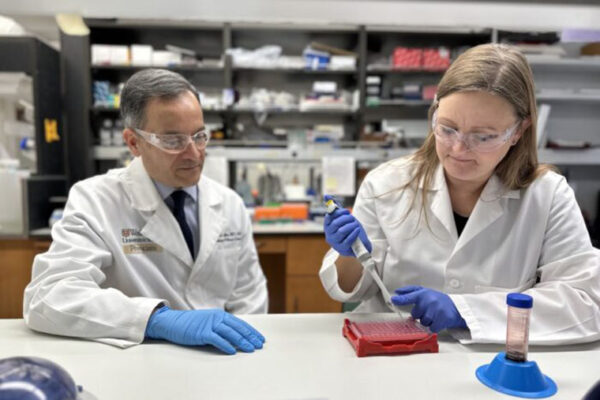
Teresa Vietti, M.D., studies a blood smear with Katherine Tsai, a third-year medical student, during Tsai's oncology/hematology rotation. "I love teaching," Vietti says. "I love taking the medical students aside and teaching them about childhood blood and cancer diseases."
Even as a little girl growing up in a rural Houston home, Teresa J. Vietti, M.D., knew she wanted to become a medical doctor. When she wasn't tending to injured chickens, immobilizing their broken legs and nursing the frail birds back to health, she spent her time studying cells under a microscope.

"When I was about 8 years old, I began saving up my monthly allowance so I could buy a microscope," Vietti says. "At an early age, there was no doubt in my mind that I wanted to go to medical school."

As the daughters of a physical chemist, Vietti and her identical twin sister, Ardel, were captivated by the mysteries of science introduced to them by their father. Both girls boldly decided to pursue careers in medicine -- in an era that didn't produce many female doctors.

They began undergraduate medical studies together at Rice University. Teresa went on to pursue her medical degree at Baylor University College of Medicine in 1949. Ardel attended the University of Texas Medical Branch in Galveston.

Only 5 percent of the students in the Baylor medical school class were female.

"Some of my teachers actually said they didn't believe women should become physicians," Vietti says

Her response to that sentiment: to excel in medicine by specializing in childhood blood and cancer diseases. One of Vietti's first projects was to establish the need for vitamin K prophylaxis in newborns. But the greatest challenge of her medical career would be finding effective therapy for childhood cancer, particularly leukemia.

For the past four decades, Vietti has been a vital force in the clinical trials of pediatric malignancies. She contributed to laboratory investigations of chemotherapeutic agents and to new drug development.

She also served as the first chair of the national Pediatric Oncology Group from 1980-1993.

Now professor emerita of pediatrics, her interests include sarcomas of soft tissue and bone as well as acute lymphoblastic leukemia.

"Dr. Vietti is a stalwart member of the faculty," says Philip R. Dodge, M.D., professor emeritus and former chair of the Department of Pediatrics. "She is an excellent teacher, clinician and an empathic physician -- and she has a great, dry sense of humor."

Twin flames

Both Teresa (right) and her identical twin sister, Ardel, knew they wanted to study medicine when they were little girls.
The pioneering spirit that drove Vietti to pursue medicine in the wake of a sexist society was a trait she shared with her twin sister. After graduating from medical school, the Vietti twins were lured to foreign lands by the desire to help underprivileged cultures.

Teresa ventured to Ankara, Turkey, where she spent six months in 1961 as a visiting pediatrician, focusing on malnutrition and infectious disease.

"Turkey was a fascinating and frustrating place," Vietti says. During her teaching post, she noticed that in some rural areas few Turkish children were living past the age of 6. The Turks had made bread with wheat supplied to them by the United States that was meant for planting.

Unfortunately, the wheat contained a fungicide that trigged a toxic reaction. Adults developed skin lesions, but young children were dying.

While Teresa was teaching young physicians in Turkey, Ardel spent five years as a medical missionary in Vietnam. Deep inside the South Vietnamese jungle, she directed a large leprosarium where she cared for 120 patients in the hospital and 1,200 outpatients.

On a late May evening in 1962, communist guerillas raided the leprosarium, capturing Ardel and her staff. Now -- after almost 40 years -- Ardel Vietti remains the only American woman still unaccounted for from the Vietnam War.

Vietti fondly remembers her sister, stressing her twin's deep religious beliefs and dedication to caring for others. A year before she was kidnapped, Ardel returned to America to visit Teresa, who had just joined the School of Medicine as an assistant professor of pediatrics. At the medical school, Ardel hoped to learn surgical procedures that would benefit her leprosy patients in Vietnam.

"I remember her visiting me at the hospital and saying, 'You spend more money in one day on one patient than I do in my whole hospital,'" Vietti says.

Child care

The vast resources and excellent level of care at St. Louis Children's Hospital have long impressed Vietti.

"Everybody's primary interest is the health of the child and returning the child back to his or her family," she says. "And I think that's fantastic."

Early in her medical career, Vietti was drawn to the unyielding determination and unstoppable spirit that children possess when it comes to fighting for their health.

"I, like many pediatricians, went into pediatrics because I don't like to have my patients die," she says.

Losing a patient, Vietti explains with anguish, is the most challenging aspect of her job.

"I've had parents console me and say, 'Dr. Vietti, you told us there wasn't a chance.' Telling parents that their child is going to die, and then trying to console them when they do die, is so difficult."

But over the course of her distinguished career, Vietti fortunately has seen mortality rates in oncology patients drastically decrease. When Vietti first entered the field of oncology/ hematology in the early '60s, the survival rate of children with cancer was only around 15 percent.

"It used to be that unless surgeons could remove the cancer, the child would die," Vietti says. "When we added radiation therapy and especially chemotherapy, there was a marked improvement in life expectancy. Now, the survival rate is about 80 percent."

And Vietti's peers insist that her medical expertise has been key to the field's profound advances.

"Dr. Vietti has complemented the field of pediatric oncology in a profound way by pioneering studies of new agents in animal models of leukemia and solid tumors," says William Crist, M.D., dean of the University of Missouri School of Medicine. "She also has strongly supported basic science and translational research within the cooperative group system, leading to formation of central reference labs and cell banks that facilitated a host of scientific discoveries."

Teresa J. Vietti, M.D.

Award highlights: The American Cancer Society Spirit of Health Award in 2001; the Leukemia Society of America Return of the Child Award in 1999; the Society of Pediatric Hematology/Oncology's Distinguished Career Award in 1994; the UNICO Award in 1976

Upcoming adventures: "I've always wanted to see the Great Barrier Reef in Australia," says Vietti, who will head Down Under later this month

Family: Her brother, Victor, an engineer, lives in Houston; her 11-year-old Maine coon cat, Peter, and two Jack Russell terriers, Spuds and Big John -- "The latter is such a little tyrant"

Hobbies: Reading scientific journals and gardening

Crist first met Vietti in 1970 when he began his fellowship in pediatric hematology/oncology at the School of Medicine. Vietti had been appointed director of the Division of Pediatric Hematology/ Oncology and soon took Crist under her wing. "She has been tireless, caring, devoted and selfless in this effort, and through her efforts, and those of a few other giants in this field, children with cancer have benefited enormously," he says.

Crist adds that Vietti supported and inspired him through her work both in the lab and clinic, and with patients. "Later, she supported me within the Pediatric Oncology Group and gave me a chance to lead," he says.

Mentoring young physicians is still a gift Vietti shares with medical students today. "A teacher is invaluable," explains third-year medical school student Vivian Yu, who recently worked with Vietti. "But a teacher who explains, encourages and befriends -- and who takes time every morning to mentor medical students -- is priceless. Dr. Vietti is that kind of teacher."

Vietti adds that she also receives endless rewards from working with bright students like Yu.

"I love teaching," she says. "I love taking the medical students aside and teaching them about childhood blood and cancer diseases."

As professor emerita of pediatrics, Vietti volunteers much of her time for teaching and academic writing. She has contributed to nearly 30 books and more than 200 publications.

Ever since she was a little girl tending to injured birds, Vietti has been devoted to medicine.

"I love medicine -- forget about everything else," she says. "It doesn't make a difference what other priorities I have, medicine always comes first."


Current Issue  |  News & Information  |  WUSTL Home

Front Page | More Stories | Medical News | Calendar | Campus Watch
Washington People | Sports | Record Staff | Employment | WU Magazine | Outlook Magazine

The Record is the University's weekly newspaper for faculty, staff and students.

Questions or comments? Contact the Record at record_editor@aismail.wustl.edu or (314) 935-6603
Technical problems with this Web site? Please contact record_bugs@aismail.wustl.edu
Copyright ©2002 Washington University in St. Louis.  All Rights Reserved.